Seerware
Seerware is the product, consulting and research work of Christopher Bates, an ML systems engineer and platform architect based in Melbourne, Australia.
I design and build technically difficult software and applied-ML systems—including Python backends, data-intensive applications, desktop products and programmable platforms—from early prototypes through deployable products.
Selected Work
PrivateCite
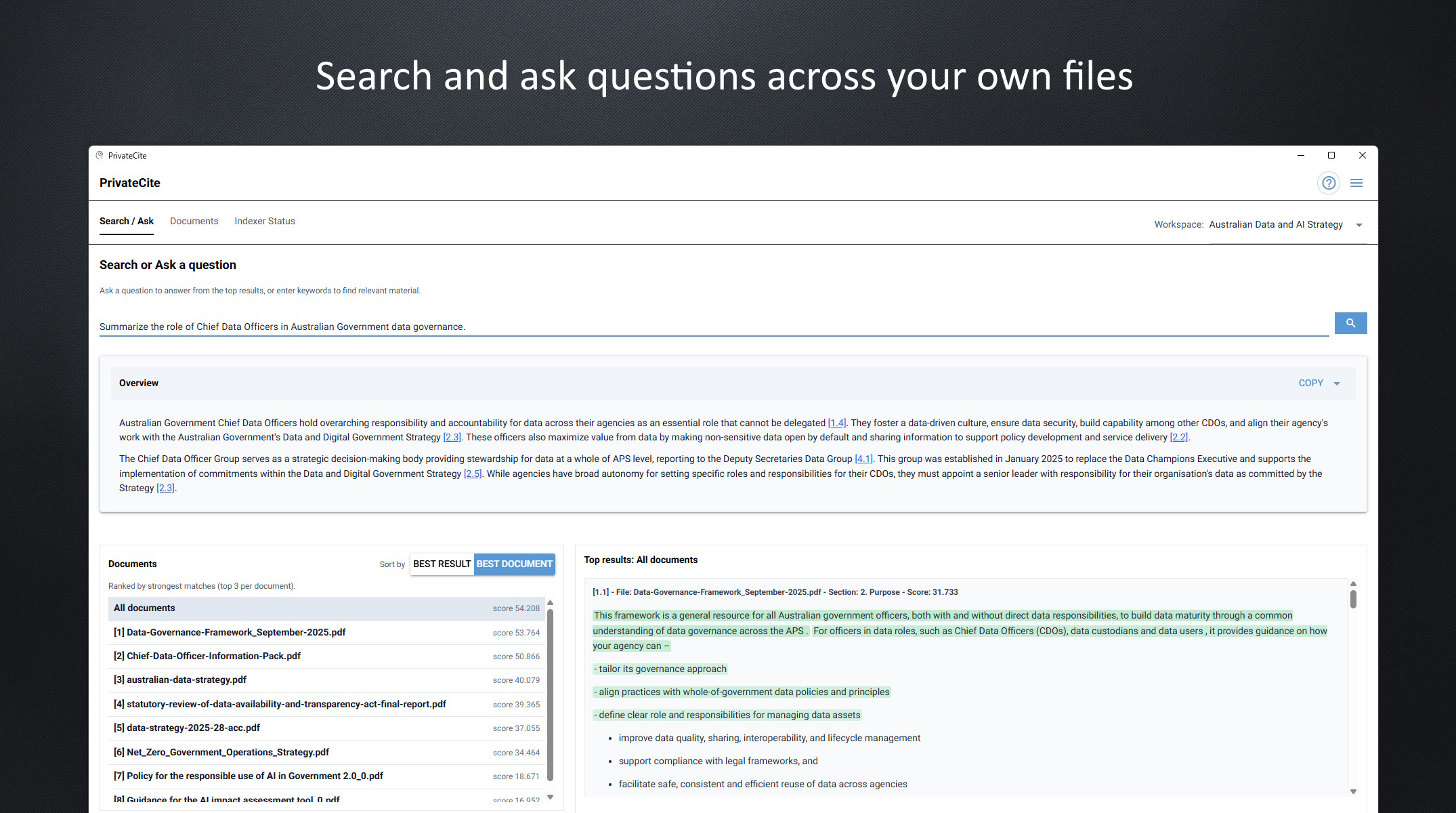
PrivateCite is a commercial Windows application for local document research and cited report generation.
PrivateCite grew from requests for systems that could review specialist operational training reports and analyse doctrine while keeping every conclusion connected to its source evidence. It turns those requirements into a reusable desktop product for people working with sensitive, technical or source-heavy material.
The application monitors selected project folders, converts and indexes documents locally, retrieves relevant passages, and uses an agentic analysis workflow to produce structured reports. References remain linked to the source passages so users can inspect the evidence directly.
Visit PrivateCite - Microsoft Store
Custom Software and Applied ML
PrivateCite is one example of the kind of end-to-end system I build. Through Seerware, I take on technically difficult products that cross software engineering, data systems and applied machine learning—from feasibility research and rapid prototypes through production implementation and deployment.
Work can include:
- Python backends, APIs, background services and data-intensive applications
- desktop applications and specialist user interfaces
- applied machine learning and deep learning, including modelling, evaluation, optimisation and production inference
- search, retrieval, ranking, recommendation and personalisation systems
- LLM applications, structured generation, agent workflows and private-model integration
- document and data ingestion, conversion, indexing and monitoring pipelines
- system architecture, technical investigation and performance engineering
- end-to-end product development for Windows, Linux and private infrastructure
I am particularly useful when a problem does not fit a standard product, contains substantial technical uncertainty, or needs one person who can work across research, architecture, backend engineering, modelling, application development and delivery.
Research
SLIP
SLIP is an experimental programming language influenced by Lisp and Rebol. I am testing it by building a persistent interactive world.
A MUD is a deliberately universal test case: it must model entities, relationships, rules, permissions, transactions, concurrent actors and evolving shared state. Those same structures recur across business applications, so ideas that survive the world model can generalise far beyond games.
SLIP starts with Lisp's code-as-data in a modern, line-oriented syntax, then uses multidispatch, first-class paths and resolvers to make rules, identity and ownership explicit. It has a working Python interpreter; the linked examples show these ideas in executable code, not just as a language proposal.
Open-Source Tools
- Etcher - persistent Python data structures backed by SQLite or Redis
- ConnorAV - fast non-normal correlated random variates in Python
- safer-yaml - YAML 1.2 support for Python with a simpler API
About Me
My background spans more than two decades of applied machine learning, information retrieval, recommendation systems, platform architecture, quantitative modelling and production software development.
I have built real-time recommendation and personalisation platforms, large-scale news search systems, high-dimensional navigation tools, econometric and operations-research models, local LLM applications and persistent simulated worlds.
More about my work and technical background
Availability
Available for consulting and contract work.
Contact
- Email: tech@seerware.com
- LinkedIn: linkedin.com/in/chris-bates-4310931
- GitHub: github.com/chrsbats